Computational biology infrastructure
in minutes, not months.
bioAF gives small biotech teams production-grade pipelines, notebooks, and experiment tracking on day one. No engineering team required.
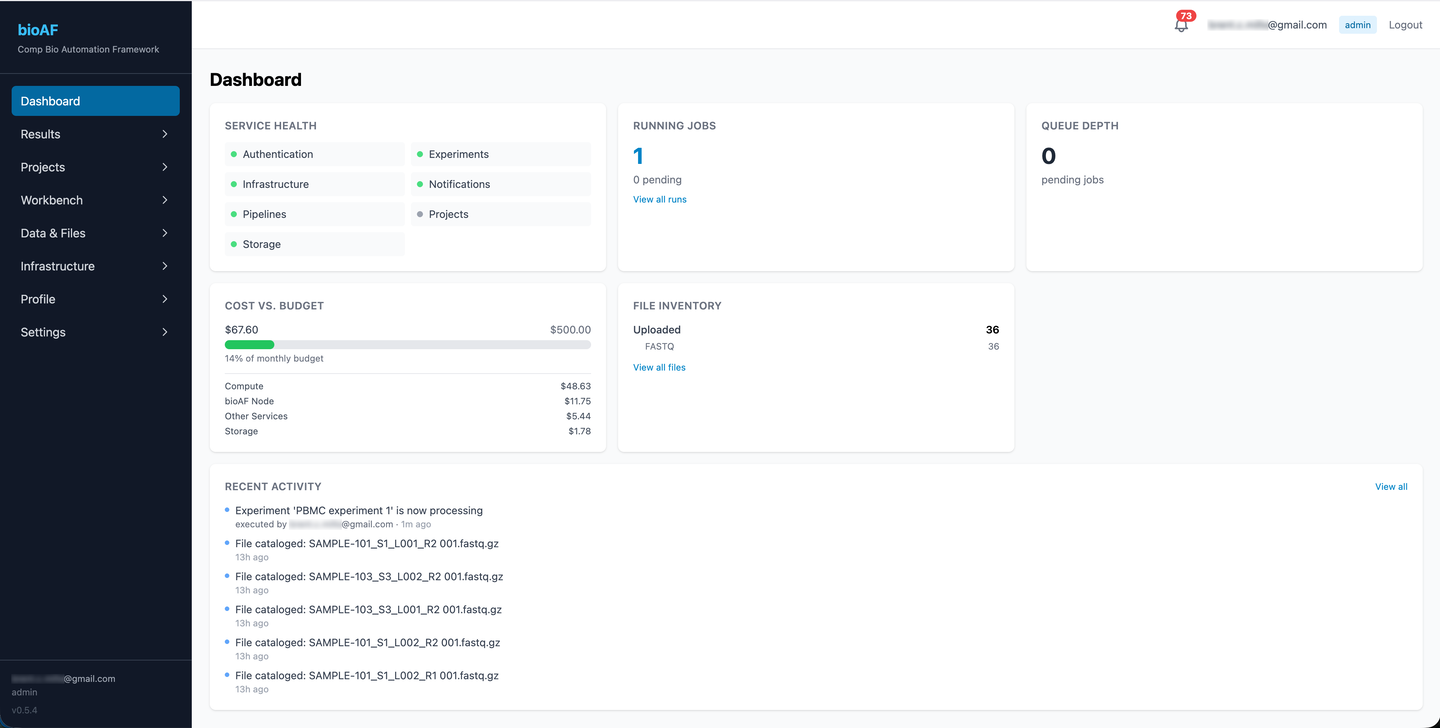
One command. One working platform.
What used to take a quarter of infrastructure work runs in the time it takes to grab coffee. No engineering team, no install guide, no babysitting.
bash <(curl -fsSL https://raw.githubusercontent.com/bioAF/bioAF/main/install-gcp.sh)
It provisions your cloud, builds the stack, and brings up every service, then prints a one-time code to claim your admin account. See the install guide →
Spend your time on the science, not the setup
Most small teams lose weeks standing up infrastructure before they analyze a single sample. bioAF hands you the finished platform, so you start with the work that matters.
Weeks spent wiring up pipelines, compute, and storage by hand.
Go from raw sequencing data to QC-ready results in hours, on infrastructure that is already running.
Sample metadata scattered across spreadsheets, inboxes, and laptops.
Every experiment, sample, and result tracked in one place, so metadata never goes missing again.
Run status and cloud costs buried across separate consoles.
See every run, result, and dollar of cloud spend in a single dashboard.
Built for your whole team
Multi-user from day one. Customizable roles and access controls grow with your team from bench to boardroom.
Bench Scientists
Register experiments, upload FASTQ files, and explore results with interactive visualizations. No command line needed.
Bioinformaticians
Run scRNA-seq pipelines, launch Jupyter or RStudio with versioned environments, and access your data, all from one place.
PIs & Founders
Track team progress, monitor cloud costs, and maintain a complete audit trail from sample to publication.
From zero to science in four steps
Deploy
Run one command on your laptop. It provisions your cloud, builds the stack, brings up every service, and prints a URL with a one-time setup code so you can claim your admin account.
What happens under the hood?
./install-gcp.sh sets up the gcloud CLI, creates the VM, firewall rules, and service account, then builds the containers, runs migrations, starts the services, and prints a one-time setup code that proves you have admin access. You choose whether the VM uses a public or private IP.
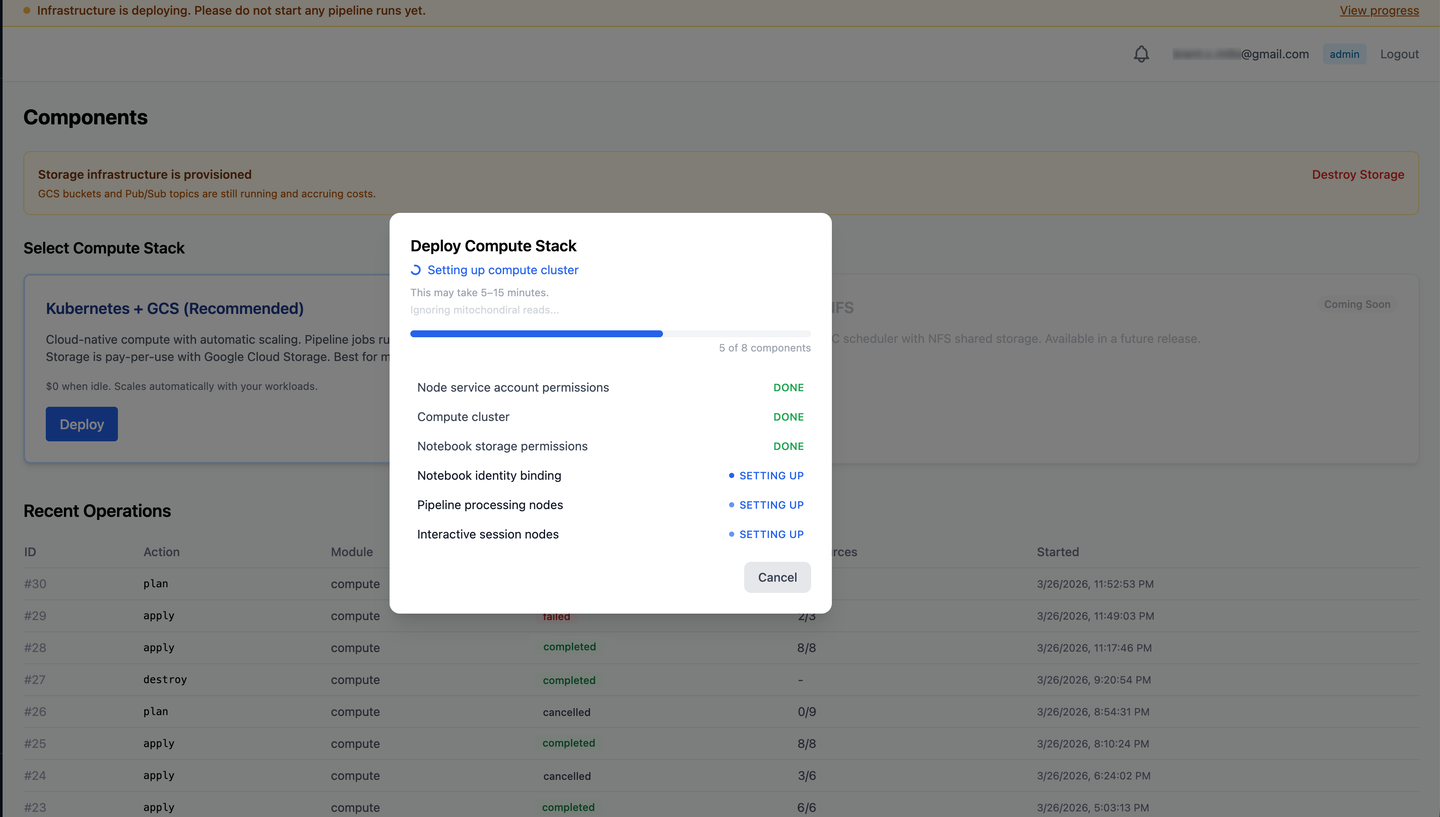
Experiment
Create experiments with structured metadata and add your samples. bioAF tracks everything from bench to results.
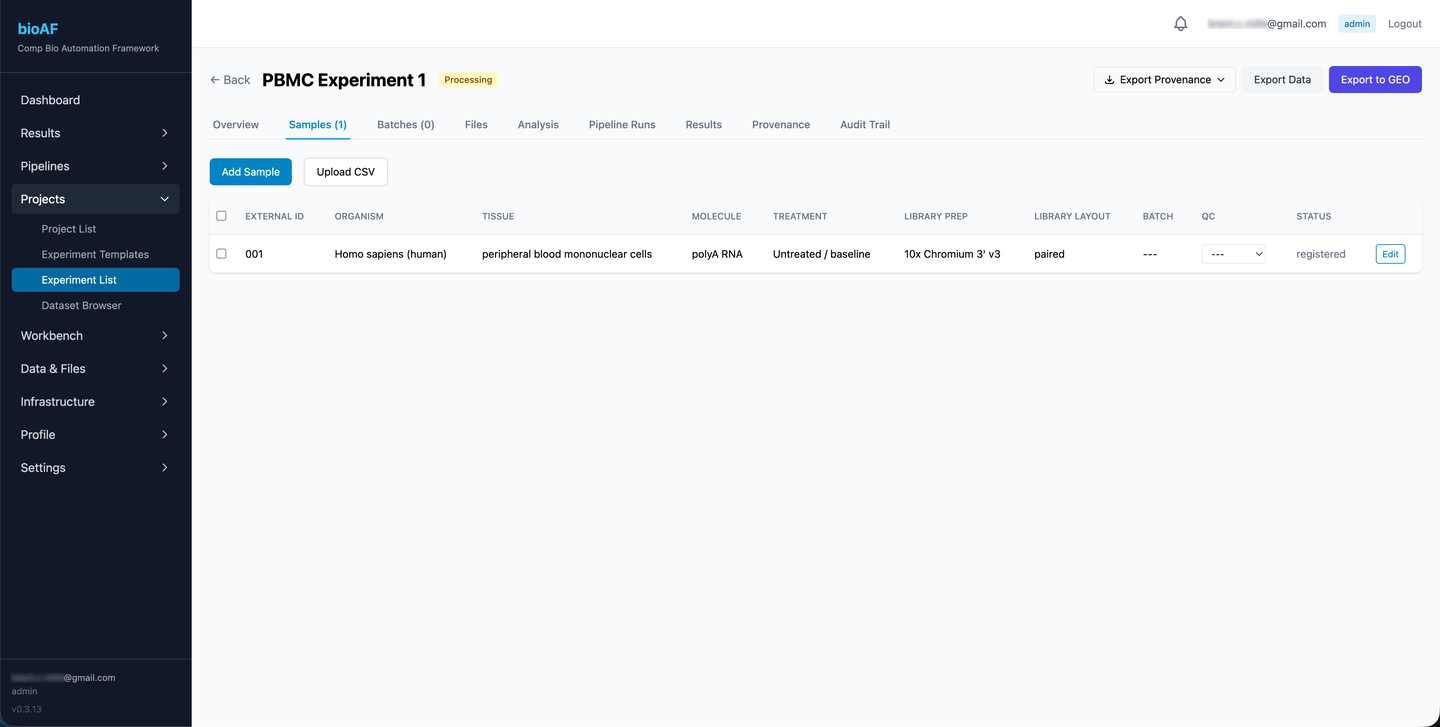
Run
Launch pipelines from the catalog or start a notebook session. Monitor progress in real time.
What pipelines are included?
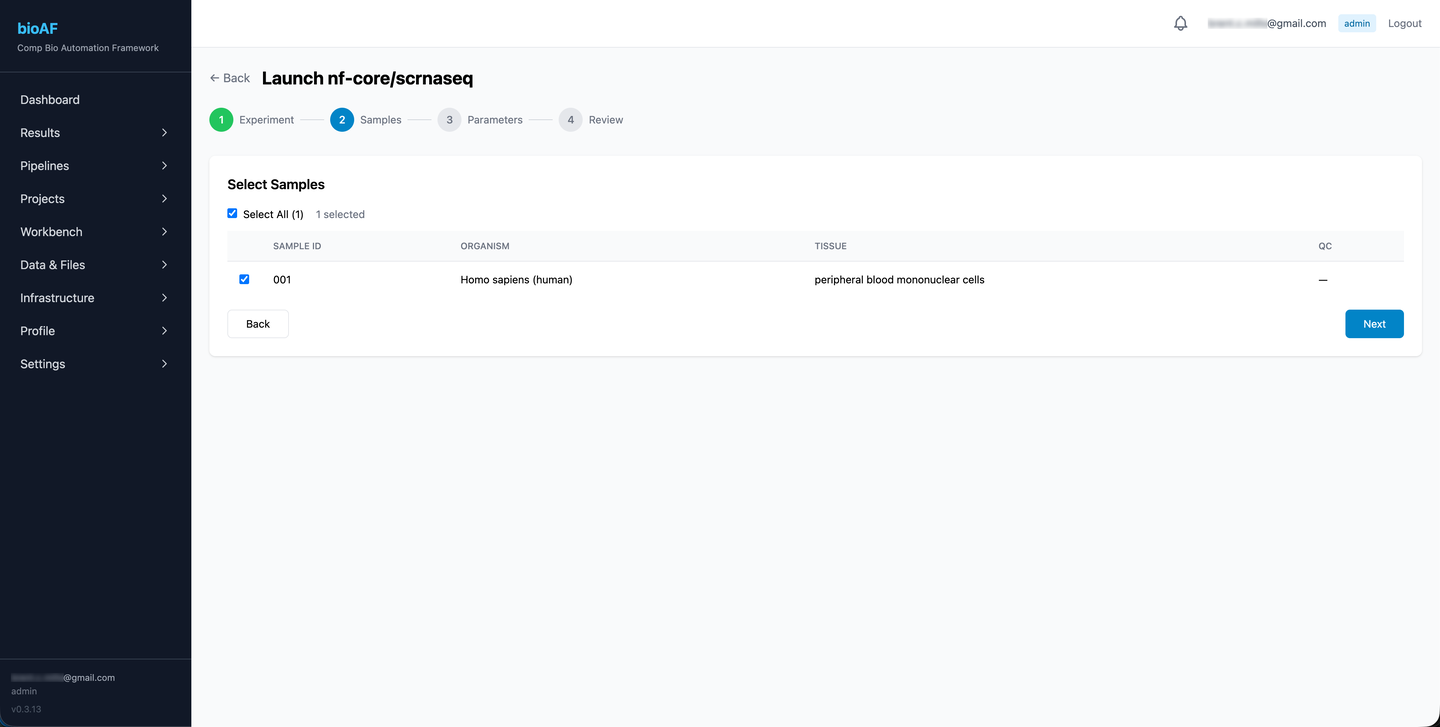
Explore
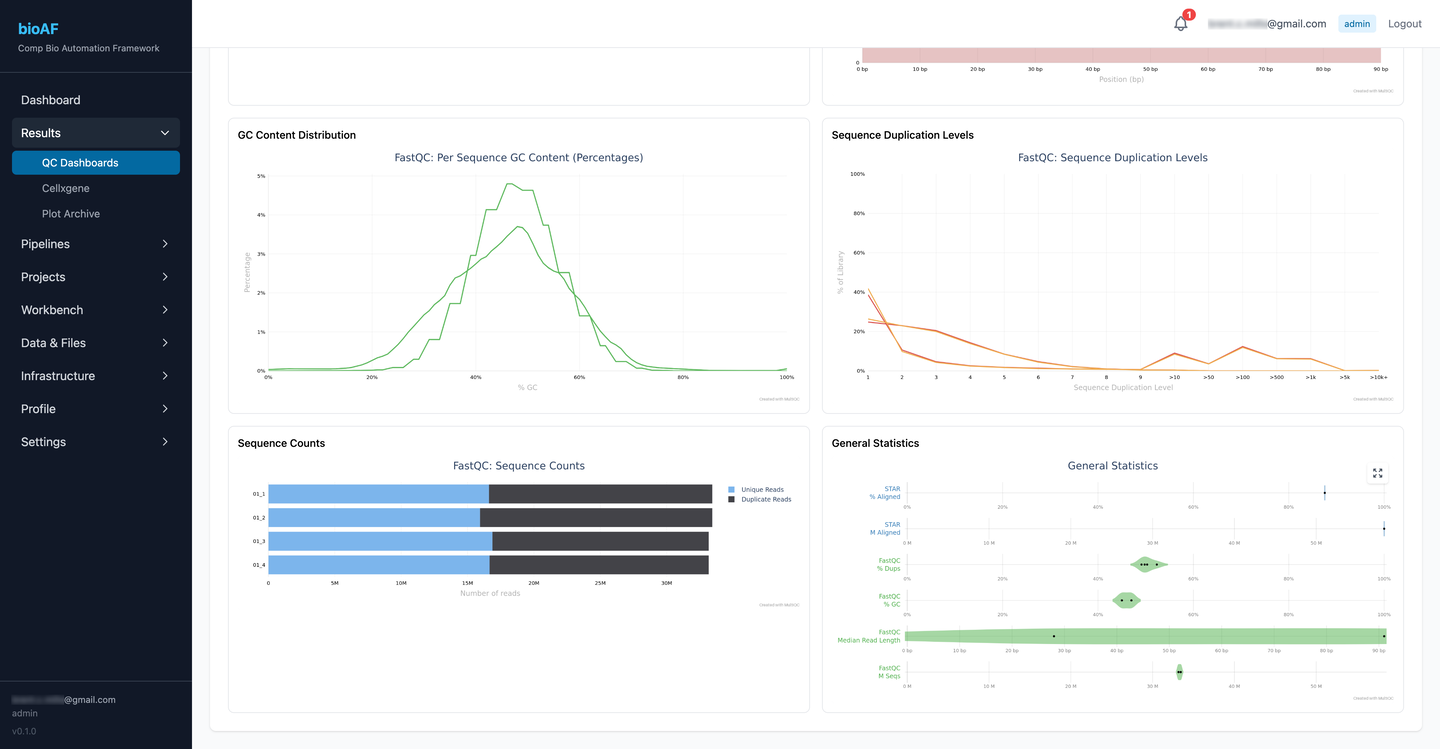
View QC dashboards, browse results in cellxgene, and share findings with your team.
Everything you need, nothing you don't
A complete platform for computational biology at small biotech scale.
bioAF Assistant
Chat with bioAF in plain language. It recommends the right pipeline, sets up experiments, and launches pipeline runs. You just ask, review, and confirm.
Meet the Assistant →Pipeline Execution
Search and install any nf-core pipeline from a live library of the full registry, or author your own. Any program that runs on Linux, version-pinned and reproducible.
Notebooks & Work Nodes
Launch JupyterHub or RStudio notebooks, or a full Linux Work Node with SSH. Versioned environments, automatic idle shutdown, and outputs that persist automatically.
Experiment Tracking
MINSEQE-compliant metadata, sample batches, and a full status lifecycle from registration to completion.
Interactive Visualization
Browse single-cell datasets in CellxGene Discover, review QC dashboards, and search the plot archive.
NewAI Review
Bring your own Claude, ChatGPT, or Gemini key. Get severity-coded LLM reviews of pipeline runs and full experiments, with complete audit logging.
NewLiterature Library
Search PubMed, bioRxiv, and more in one place, then let AI Literature Review recommend the most relevant new papers for each experiment, automatically.
NewLIMS Integration API
Connect bioAF to Benchling, LabKey, or your in-house LIMS over a key-authenticated REST surface, with signed outbound webhooks to react to changes.
Fits the stack you already have
bioAF connects to your lab systems, your AI provider, and your data sources, so adopting it doesn't mean ripping anything out.
Lab systems & LIMS
Sync projects, experiments, and samples over a key-authenticated REST API, with signed webhooks that react to changes.
AI providers
Bring your own key to power the bioAF Assistant, AI Review, and AI Literature Review. One active provider per org, switchable in a click.
Instruments & CROs
Auto-ingest new files as they land, so raw data flows into the right experiment without manual uploads.
Literature databases
Search every source from one place and pull the papers you keep into a shared library.
Powered by tools that stand on their own
bioAF is an orchestration layer, not a walled garden. It builds on industry standard tools you already know.
Industry-standard foundations
Everything bioAF provisions and manages (Kubernetes, PostgreSQL, Nextflow, JupyterHub, RStudio, object storage like GCS or S3) is mature, widely-adopted, and has large communities behind it. bioAF didn't invent any of it. It just wires it together.
You own everything
Your data lives in your own cloud account, GCP or AWS. Your infrastructure is defined in Terraform you can export at any time. There are no proprietary formats, no hosted dependencies, and no gates between you and your own work.
Replace bioAF at any time
If your needs change, or if this project stops being maintained, you can replace bioAF's control plane with your own tooling and everything underneath keeps working. The pipelines still run. The data is still there. The notebooks still launch.
Bioinformatics


Analysis & Compute



Infrastructure






Open source, and yours to keep
bioAF runs on your own cloud account, with your data and infrastructure under your control. Here is how that compares to a typical commercial platform.
| What matters | bioAF (open source, self-hosted) | Typical commercial platform |
|---|---|---|
| Where your data lives | Your own cloud account (GCP or AWS) | The vendor's cloud |
| Hosting | Self-hosted, fully under your control | Hosted for you, on the vendor's terms |
| Lock-in | Built on common, open tools and standard formats; nothing proprietary to migrate off | Proprietary formats; migrating out is a project |
| Pricing | Free and open source; you pay only your cloud bill | Per-seat or per-sample subscription |
| Source code | Open and auditable; yours to fork | Closed |
A general comparison with self-hosted, open-source tooling in mind. Specifics vary by vendor.